Octopus cAI — Autonomous Security Investigation
Autonomous Investigation. Evidence-Driven Decisions.
Security operations cannot move at machine speed when every investigation depends on manual evidence gathering, disconnected workflows, and sequential decisions.
HAWK Octopus cAI supports autonomous security investigation by connecting investigative context, relevant evidence, and AI-driven analysis to help security teams reach defensible conclusions and determine appropriate next steps.
Built for HAWK's evidence-driven security operations approach, Octopus cAI helps bridge the gap between detecting suspicious activity and making informed response decisions.
More Alerts Do Not Mean Better Investigations
Modern security teams collect enormous amounts of telemetry across endpoints, networks, cloud environments, identity systems, and security tools.
The challenge is not simply detecting additional suspicious activity.
It is establishing which signals matter, collecting relevant evidence, understanding the threat, and determining what action is justified.
When those activities depend on manual handoffs, investigation time increases and response decisions can be delayed.
Octopus cAI is designed to support the investigation process—not simply generate more alerts or summaries.
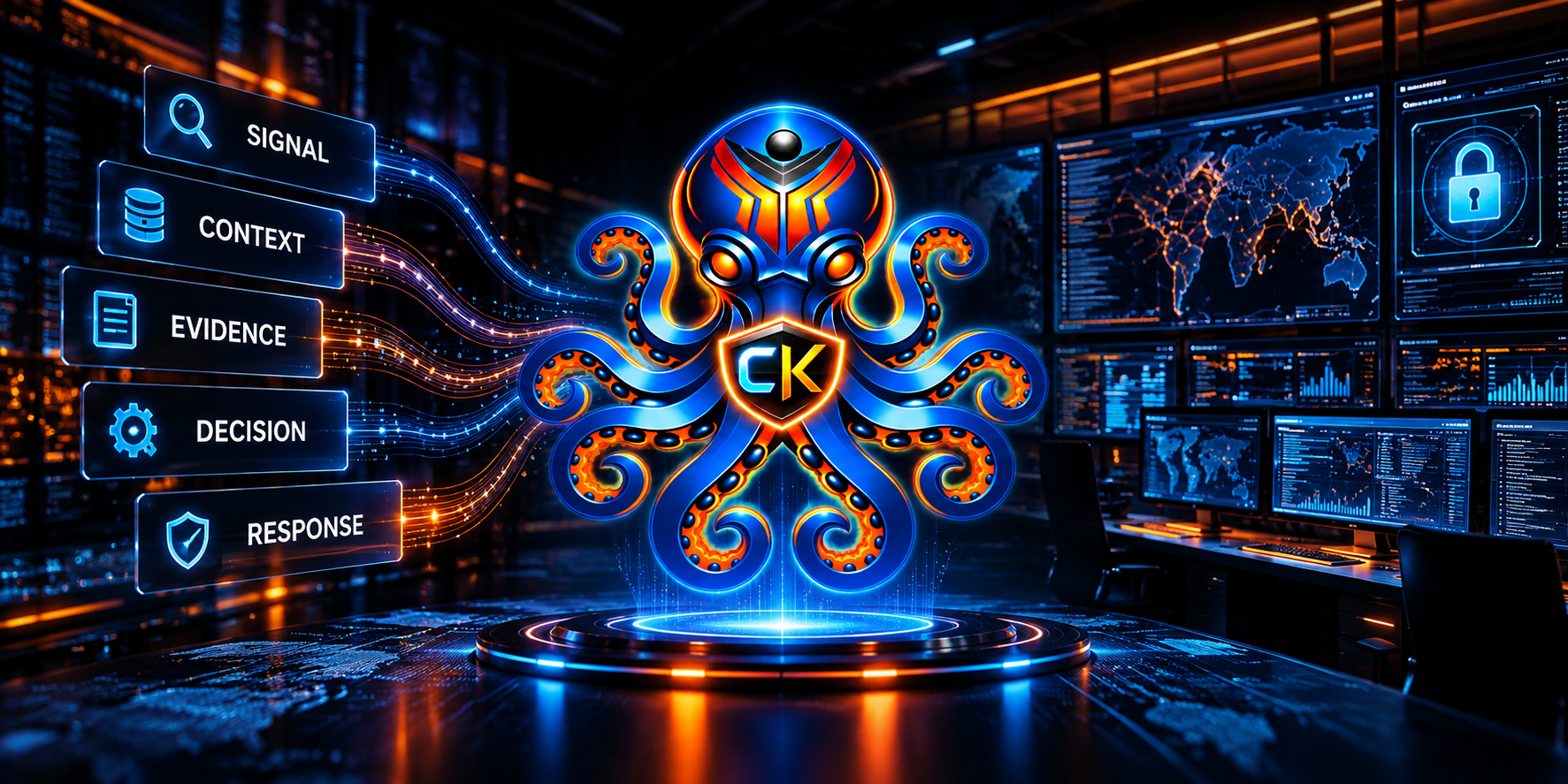
How Octopus cAI Supports Autonomous Investigation
From security signals to evidence-supported decisions.
An effective AI-driven investigation must connect multiple elements of the security operations lifecycle.
1. Establish Investigative Context
Security signals require context before they can support meaningful conclusions.
Octopus cAI supports investigation by working with relevant security information to help establish what activity occurred and why it warrants attention.
2. Evaluate Relevant Evidence
Investigative conclusions should be supported by evidence rather than assumptions or isolated alerts.
HAWK's evidence-driven approach connects relevant investigative information with AI-driven analysis.
3. Support Validated Findings
The objective is to develop findings that can be examined, challenged, and used to inform appropriate decisions.
Evidence-supported findings help distinguish meaningful security activity from information that does not justify further action.
4. Inform Response Decisions
Investigation results must support a clear operational decision.
Octopus cAI contributes investigative context and analysis that can inform escalation, response priorities, and coordinated action within HAWK's security operations approach.
By connecting validated findings with relevant evidence, Octopus cAI helps security teams determine appropriate next steps while maintaining defined response authority and human oversight.
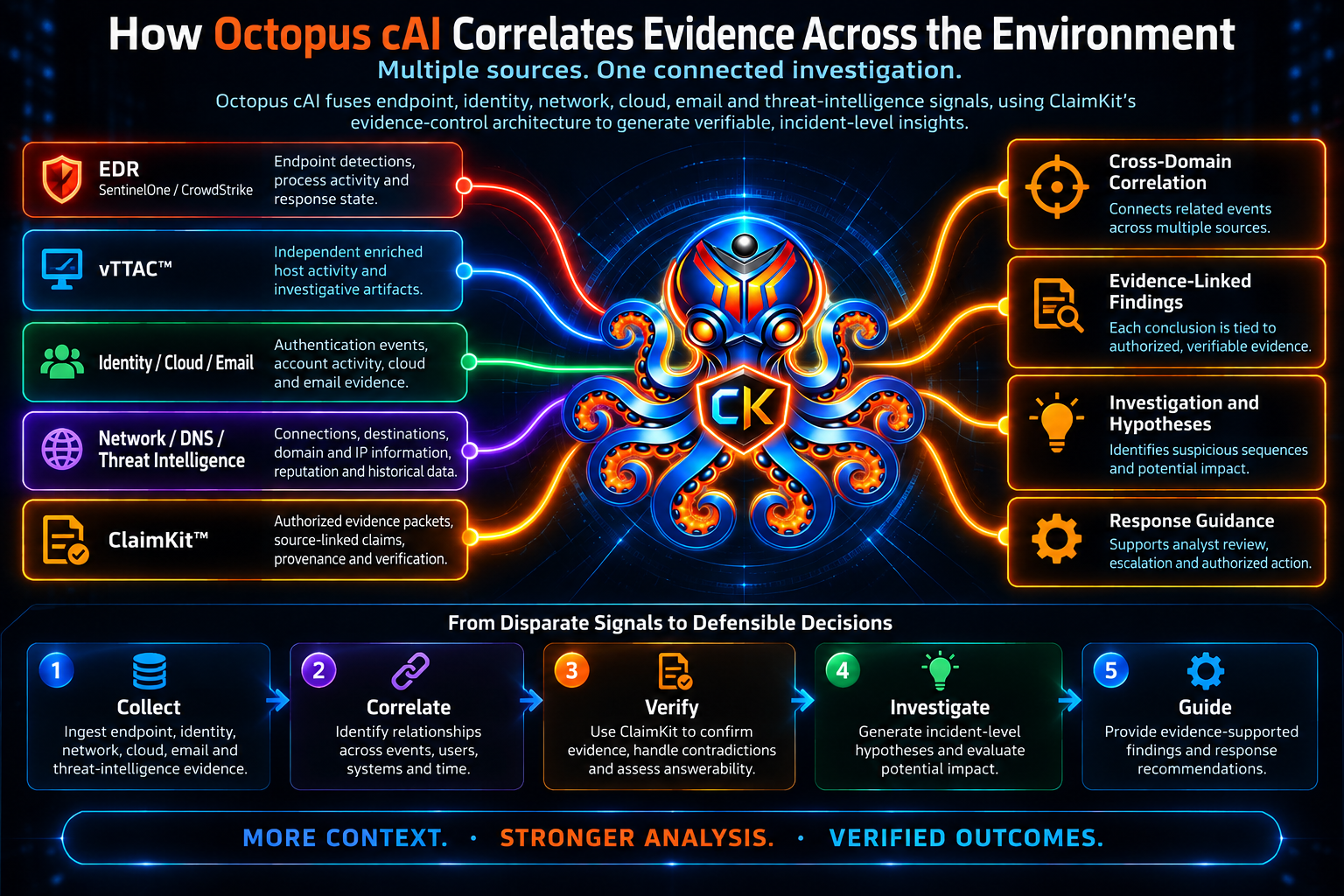
How Octopus cAI Correlates Evidence Across the Environment
An endpoint detection is an important signal. It is not always the complete incident.
Security activity rarely exists in isolation. An endpoint event may be connected to identity activity, cloud access, network communications, email events, or historical threat intelligence.
Octopus cAI brings these sources into a broader investigative context, helping security teams understand how individual observations relate to an incident.
The Evidence Behind the Investigation
Existing Endpoint Detection and Response (EDR)
Provides endpoint detections, process activity, and response-state information. Existing EDR technologies remain important prevention, detection, and response controls.
HAWK vTTAC — Independent Endpoint Evidence
Provides enriched host activity and investigative artifacts, adding an independent source of endpoint context that complements existing EDR technologies.
Identity, Cloud, and Email
Provide authentication events, account activity, cloud observations, and email-related evidence that may change how endpoint behavior is interpreted.
Network, DNS, and Threat Intelligence
Provide network connections, destinations, domain and IP information, reputation data, and historical observations.
HAWK’s Patent-Pending ClaimKit — Evidence Control and Verification
Provides the evidence-control layer for AI-supported conclusions, including source-linked claims, authorization, provenance, and verification.
Octopus cAI — Correlation and Investigation
Connects available evidence across these sources to support incident-level hypotheses, investigation, and response decisions.
From Multiple Signals to Defensible Decisions
The objective is not simply to collect more telemetry.
It is to determine what the combined evidence establishes about suspicious activity, what remains uncertain, and whether the findings justify further investigation, escalation, or an authorized response.
By connecting independent endpoint evidence with broader security context and ClaimKit's evidence-control architecture, Octopus cAI supports investigations grounded in more than a single detection or isolated event.
Better investigations begin with connected evidence—not just additional alerts.
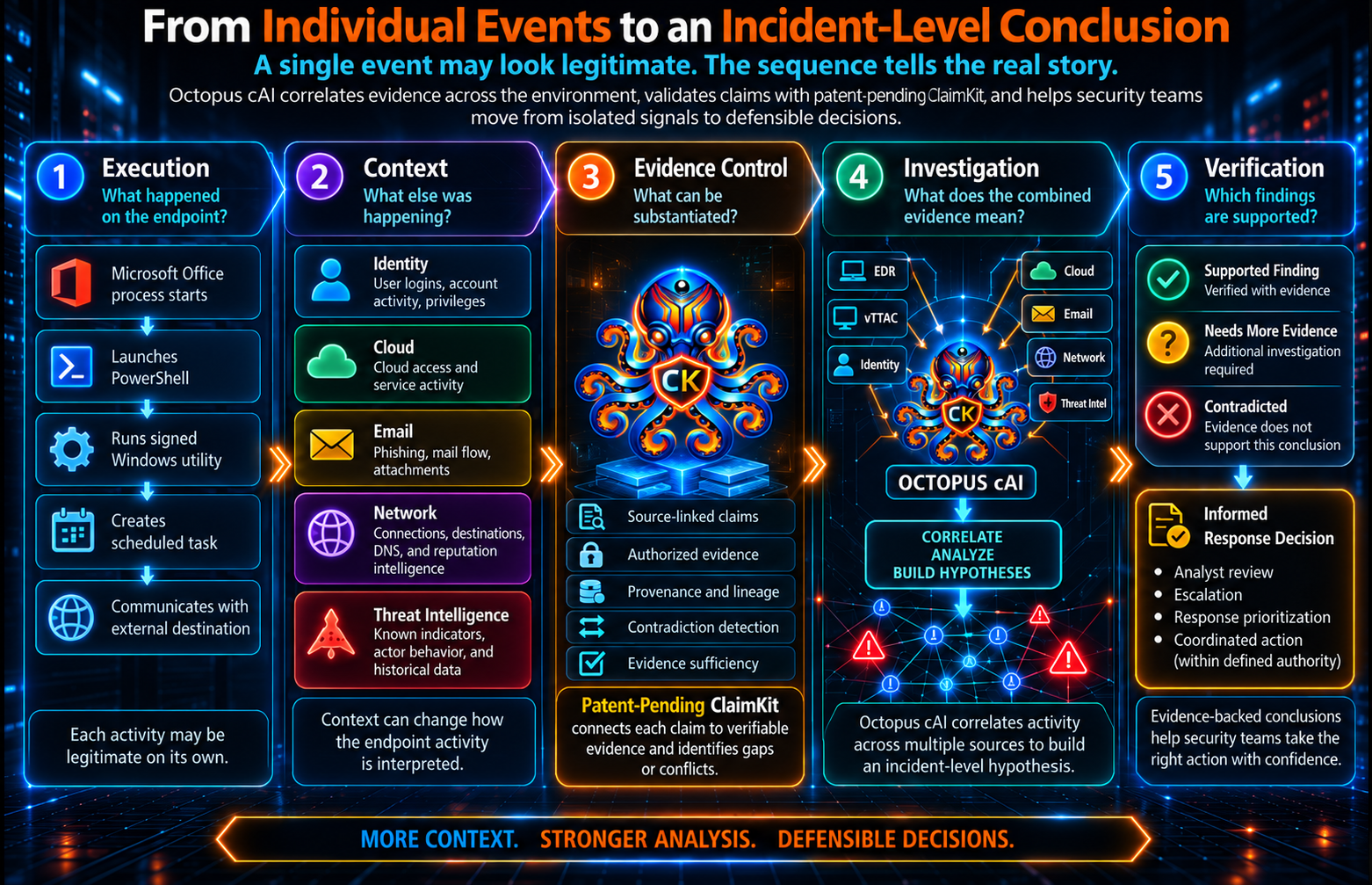
From Individual Events to an Incident-Level Conclusion
An individual event may look legitimate. The sequence can tell a different story.
Consider a potential living-off-the-land attack involving legitimate Windows tools.
A trusted Microsoft Office process launches PowerShell. PowerShell invokes a signed Windows utility to retrieve or decode content. A scheduled task is created. Later, the endpoint communicates with a previously unseen network destination.
Each activity may have a legitimate administrative explanation.
The investigative significance emerges when the events are evaluated together.
How the Evidence Builds an Investigation
1. Execution — What Happened on the Endpoint?
Existing EDR technology observes endpoint behavior and may identify or block suspicious activity.
HAWK vTTAC adds independent host evidence, including available process relationships, execution context, and related investigative artifacts.
2. Context — What Else Was Happening?
Endpoint observations are evaluated alongside relevant identity, network, cloud, and threat-intelligence information.
This broader context helps determine whether the activity is isolated, expected, or potentially part of a suspicious sequence.
3. Evidence Control — What Can Be Substantiated?
HAWK ClaimKit provides an evidence-control architecture that connects investigative assertions to supporting records.
Its approach addresses evidence authorization, provenance, contradictions, and whether the available information is sufficient to support a conclusion.
4. Investigation — What Does the Combined Evidence Mean?
Octopus cAI correlates the available observations into an incident-level hypothesis.
Rather than evaluating each event independently, the investigation considers the relationships among execution activity, identity context, network behavior, and supporting evidence.
5. Verification — Which Findings Are Supported?
ClaimKit-backed verification helps distinguish evidence-supported findings from assertions that remain unsubstantiated.
The resulting investigation can inform analyst review, escalation, or response decisions within defined authority.
The Advantage of Independent Evidence
The distinction is not that modern EDR technologies cannot detect living-off-the-land attacks.
SentinelOne, CrowdStrike, and other advanced EDR products already provide sophisticated behavioral detection.
HAWK's architectural advantage is the addition of an independent evidence path and cross-domain investigative context.
A sequence that does not produce an endpoint alert should not automatically become an invisible sequence.
By connecting independent observations, controlled evidence, and AI-driven investigation, HAWK helps security teams evaluate activity that may be more significant collectively than any individual event suggests.
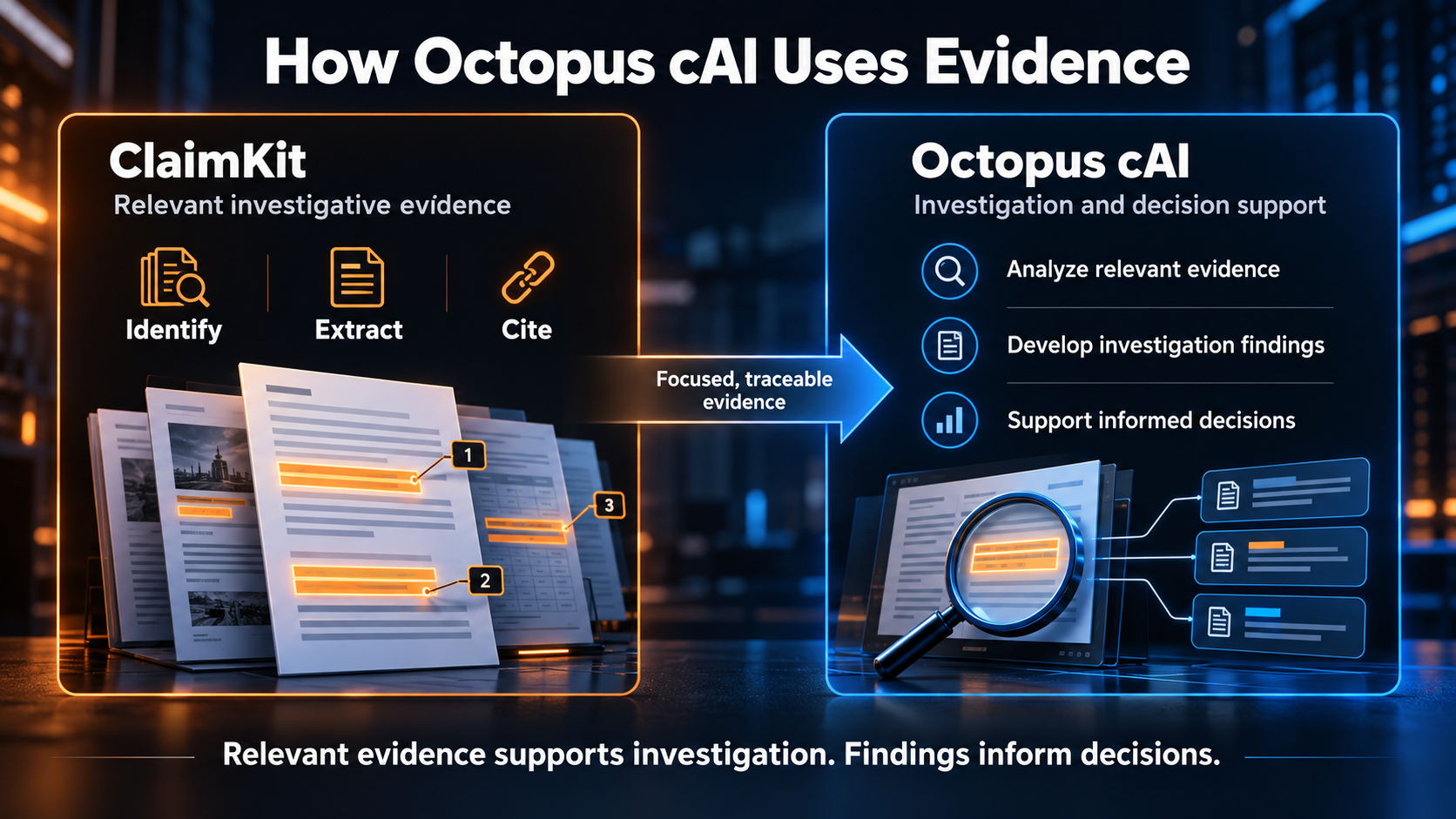
Octopus cAI + ClaimKit: Focused Evidence for AI Investigation
Better AI investigations begin with better evidence.
Retrieving large volumes of security information does not automatically improve investigation quality.
Relevant evidence must be identified, selected, and connected to the findings it supports.
HAWK ClaimKit is evidence intelligence technology that identifies, extracts, and cites relevant investigative evidence.
ClaimKit provides focused investigative evidence for Octopus cAI, supporting AI-driven analysis with information that can be traced to its source.
This relationship connects two important capabilities:
ClaimKit: Focused evidence identification, extraction, and citation.
Octopus cAI: AI-driven investigation and decision support using relevant investigative context.
Together, they support an evidence-driven approach to security investigation in which conclusions can be evaluated against the information behind them.
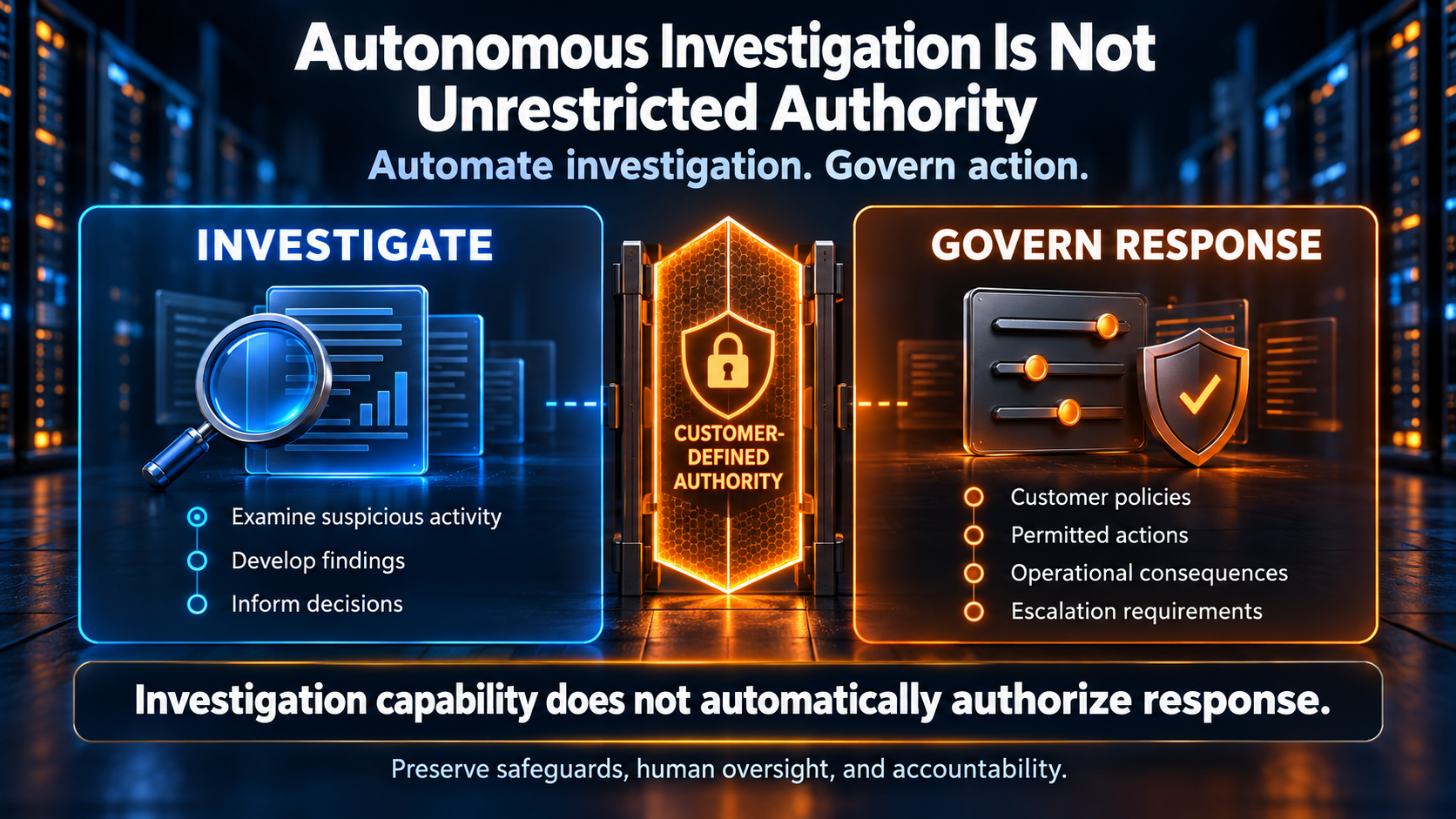
Autonomous Investigation Is Not Unrestricted Authority
Automate investigation. Govern action.
Autonomous investigation and autonomous response are not interchangeable concepts.
The ability to investigate suspicious activity does not automatically establish authority to change systems, isolate assets, or disrupt business operations.
Response authority must account for customer policies, permitted actions, operational consequences, and escalation requirements.
HAWK's security operations approach emphasizes defined customer authority and coordinated response.
The objective is to reduce unnecessary delays while preserving appropriate safeguards, human oversight, and accountability for consequential actions.
From Investigation to Coordinated Response
The value of investigation is realized when it supports the right action.
Security operations require more than identifying suspicious activity.
Teams must understand the threat, establish supporting evidence, determine whether action is justified, and verify the outcome.
Octopus cAI supports the investigative and decision-making elements of this process.
Within HAWK MDR, evidence-driven investigation contributes to a coordinated approach connecting detection, investigation, response, and outcome verification.
The goal is not automation for its own sake.
It is to help security teams make better-supported decisions with less operational friction.
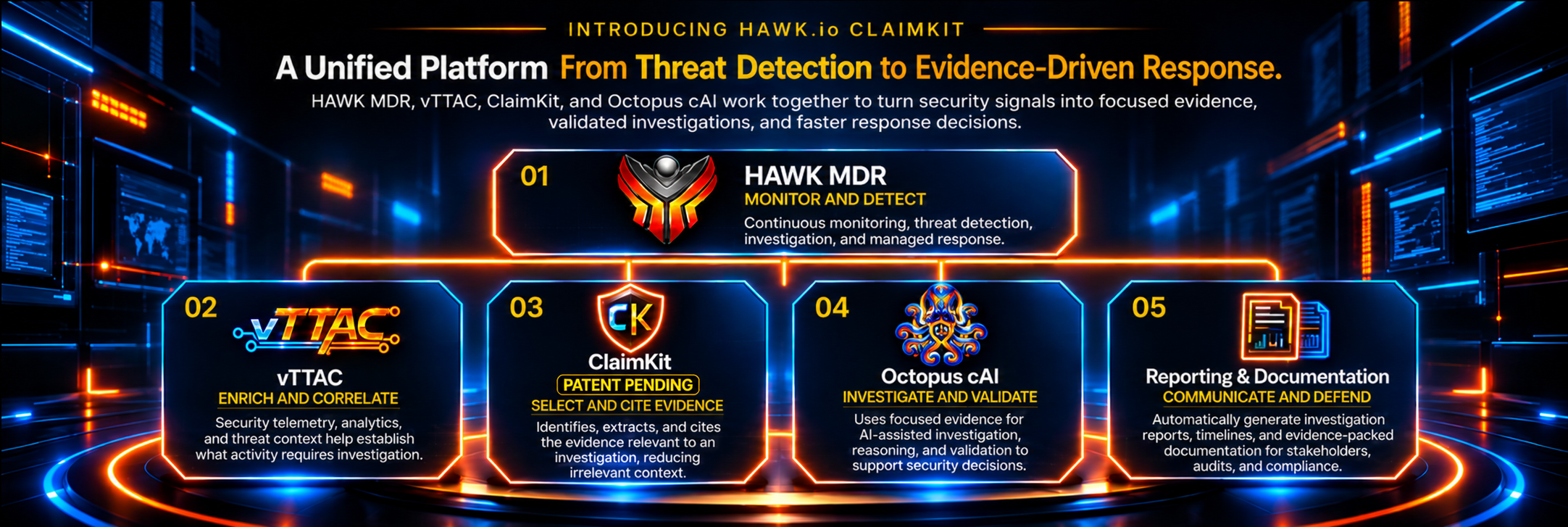
Part of HAWK's AI-Driven MDR Approach
Octopus cAI is part of HAWK's broader approach to managed detection and response.
HAWK MDR connects security telemetry, investigation, evidence intelligence, and coordinated response to strengthen security operations.
Supporting technologies include:
HAWK vTTAC — Independent endpoint telemetry and investigative evidence that complement existing endpoint protection.
HAWK ClaimKit — Focused evidence identification, extraction, and citation.
HAWK Octopus cAI — AI-driven investigation and decision support.
These capabilities contribute to an operating model designed to improve the connection between security signals, validated findings, and appropriate action.
Frequently Asked Questions
What is HAWK Octopus cAI?
Octopus cAI is HAWK's AI-driven security investigation and decision-support technology. It supports the analysis of suspicious activity using relevant investigative context and evidence.
How does Octopus cAI use ClaimKit?
HAWK’s patent-pending ClaimKit identifies, extracts, and cites relevant investigative evidence. This focused evidence supports Octopus cAI's investigation process and helps establish traceability between investigative information and findings.
Is Octopus cAI an autonomous security investigation technology?
Octopus cAI supports autonomous security investigation. Its role is to help analyze security activity and inform decisions. Autonomous investigation should not be confused with unrestricted authority to execute response actions.
Does Octopus cAI replace security analysts?
Octopus cAI is intended to support security operations by reducing investigation friction and helping analysts work from relevant evidence. Human expertise remains important for oversight, exceptions, consequential decisions, and operational accountability.
How does Octopus cAI relate to HAWK MDR?
Octopus cAI supports the AI-driven investigation capabilities within HAWK's broader managed detection and response approach, connecting investigative analysis with evidence-driven security decisions.
Security Operations Built for Machine Speed
Machine-speed investigation. Evidence-driven decisions. Human accountability.
Discover how HAWK combines AI-driven investigation, relevant evidence, and coordinated response to support more effective security operations.