

What is HAWK.io ClaimKit?
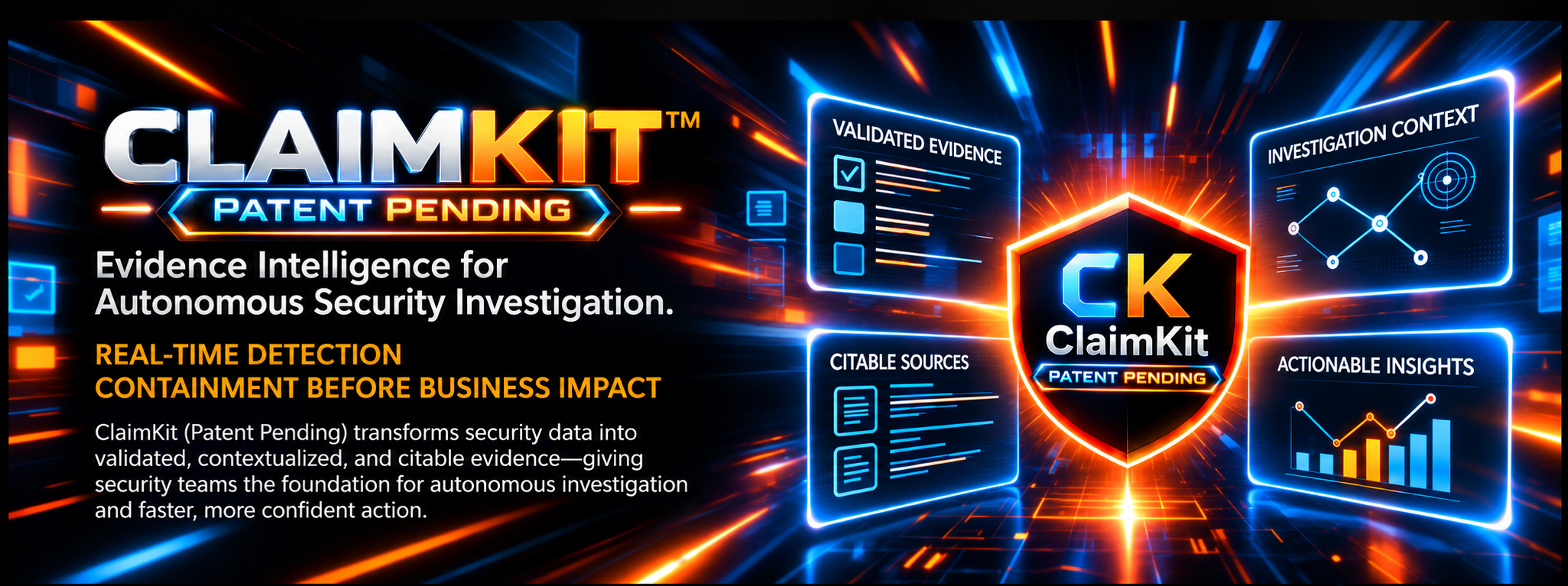
HAWK.io ClaimKit is a patent-pending evidence intelligence technology within the HAWK security operations platform. It identifies, extracts, and cites relevant investigation evidence, helping AI-assisted security investigations use validated evidence to support analysis and operational decisions.

Evidence Intelligence for Security Investigations
Give AI the Evidence It Needs—Not Everything You Have.
More security data does not automatically produce better security decisions.
ClaimKit transforms source information into structured, traceable evidence that AI can use to generate and verify answers. Rather than relying solely on raw document chunks, ClaimKit extracts individual, verifiable claims and preserves their connection to the original source.
Within the HAWK security operations platform, ClaimKit provides focused evidence that supports Octopus cAI's autonomous investigation, reasoning, and validation.
Less irrelevant context. More verifiable evidence. Better-supported decisions.
What Happens When the Evidence Is Incomplete?
Security investigations rarely begin with a complete picture.
Endpoint activity may be missing context. Identity events may contradict other observations. Historical evidence may be outdated. An AI-generated explanation may sound convincing even when the available evidence does not support every conclusion.
A credible security investigation must distinguish what is known, what remains uncertain, and what cannot yet be established.
ClaimKit's patent-pending evidence-control architecture is designed to evaluate these distinctions before an AI-generated conclusion is treated as verified.
Evidence Sufficiency and Answerability
The ClaimKit architecture defines several possible evidence states:
Answerable: Available evidence is sufficient to support the requested conclusion.
Partially answerable: Some conclusions are supported, but important questions remain unresolved.
Not answerable: The available evidence does not establish a defensible conclusion.
Conflicting evidence: Sources contain contradictions that must be identified and addressed.
Requires live source: Current information is needed before the conclusion can be supported.
Requires human approval: The investigation or resulting decision requires authorized human judgment.
Verification Before Confidence
ClaimKit links factual assertions to identifiable supporting evidence, including source references and evidence locations.
Its architecture also accounts for evidence freshness, trust, contradictions, and superseded information.
Generated assertions can be checked against the authorized evidence packet. Unsupported statements may be removed, and verified status can be withheld when the evidence does not substantiate the conclusion.
This is particularly important when an AI investigation addresses consequential questions:
Was an endpoint actually compromised?
Does the evidence establish lateral movement?
Is a suspicious connection related to the incident?
Can the available records support an attribution or impact assessment?
Is the evidence sufficient to justify a response recommendation?
The objective is not to make AI sound more certain. It is to make its conclusions more defensible.
For HAWK Octopus cAI, ClaimKit provides a foundation for evidence-constrained investigation, helping distinguish verified findings from unsupported assumptions before those findings inform security decisions.
From Security Data to Investigation Evidence
ClaimKit does more than retrieve information.
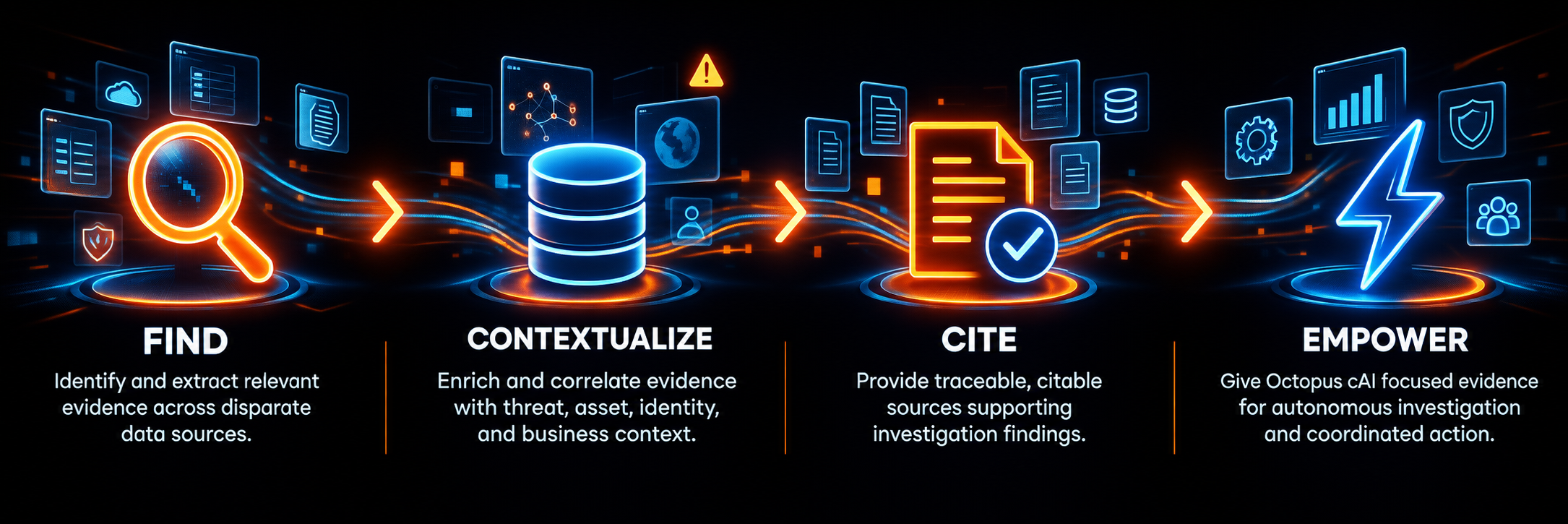
It extracts atomic claims from source documents, identifies relevant supporting passages, and preserves the evidence needed to substantiate each claim.
Its evidence-first architecture incorporates:
Claim extraction: Identifies individual statements that can be evaluated independently.
Evidence provenance: Connects claims to their supporting source passages, including character-level offsets.
Contradiction detection: Identifies conflicting information rather than silently combining contradictory sources.
Answerability assessment: Evaluates whether the available evidence is sufficient to support an answer.
Answer verification: Checks generated claims and citations against the supporting evidence.
ClaimKit transforms retrieved information into evidence that can be traced, evaluated, and verified.
Why Evidence Selection Comes Before AI Investigation
Autonomous security investigations depend on the quality and relevance of the evidence available for reasoning. Providing an AI system with more security data does not necessarily improve its conclusions.
HAWK.io ClaimKit identifies, extracts, and cites relevant evidence before that evidence is used by Octopus cAI. By preparing focused, traceable evidence, ClaimKit helps reduce irrelevant context and preserves the connection between investigative findings and their supporting sources.
This approach supports more defensible investigation results, clearer validation, and better-informed security decisions. Evidence selection does not eliminate the need for verification; it establishes a stronger foundation for it.
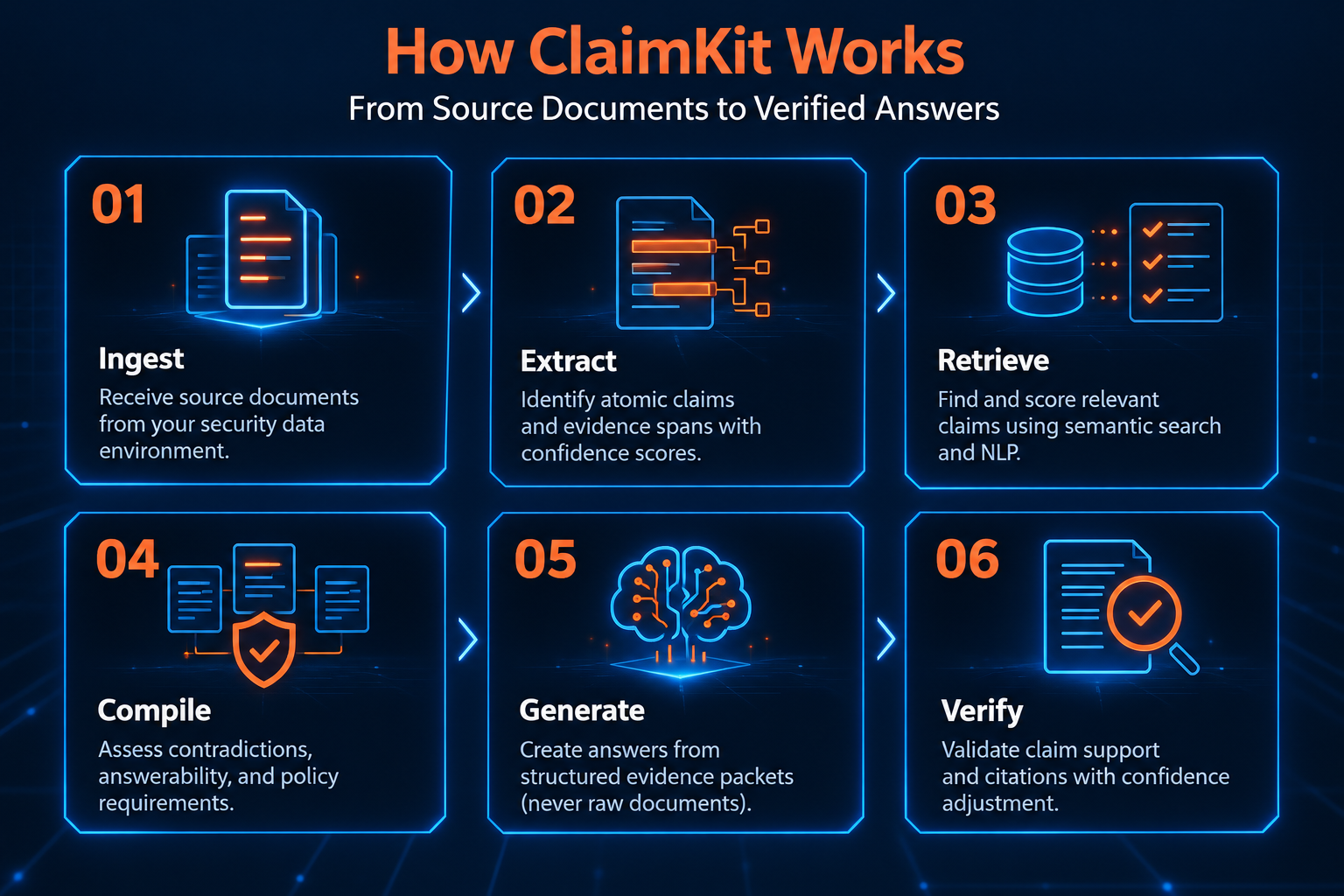
ClaimKit transforms source documents into structured, verifiable evidence through six stages: ingestion, atomic claim extraction, semantic retrieval, evidence compilation, answer generation, and verification. Its evidence-first architecture preserves source traceability, detects contradictions, assesses answerability, and validates generated claims and citations against supporting evidence. Unlike conventional chunk-based Retrieval-Augmented Generation (RAG), ClaimKit provides AI with focused evidence packets rather than raw document chunks, reducing unnecessary context while supporting more accurate, evidence-grounded security investigations.
Spend Less Time Assembling Evidence
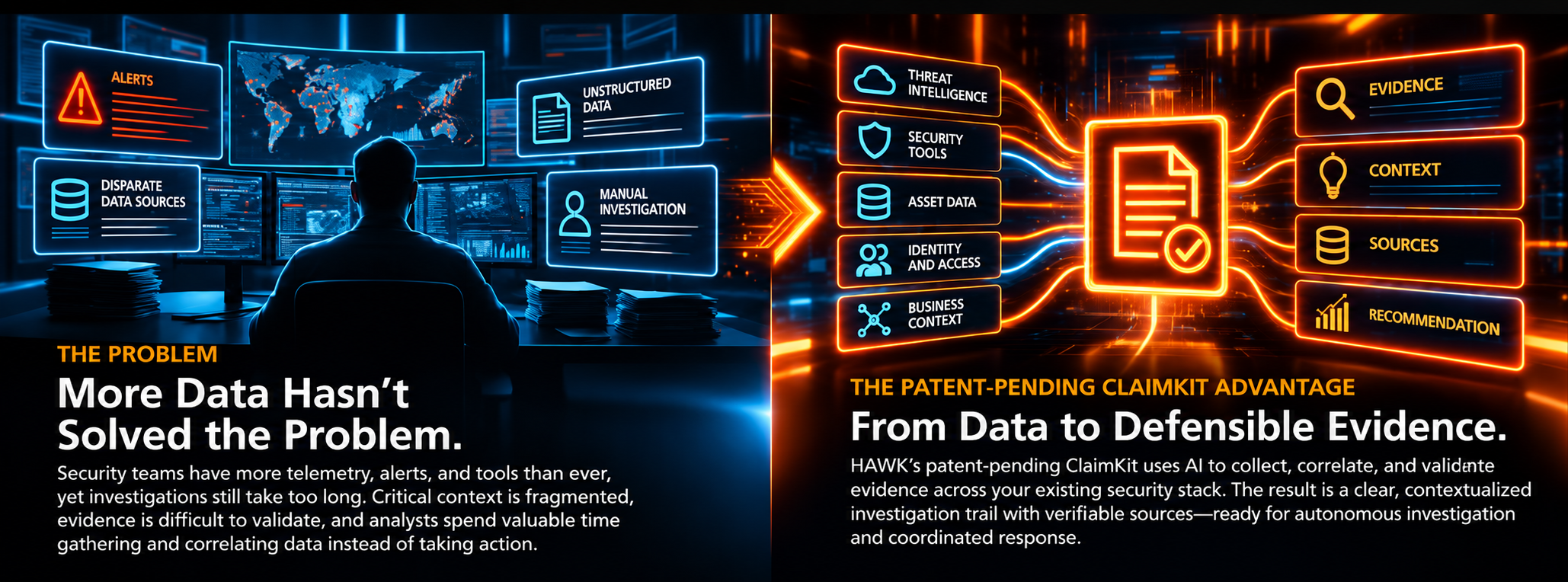
Security investigations often require analysts to search across disconnected tools, correlate information, resolve conflicting findings, and determine which evidence actually supports a conclusion.
ClaimKit selects relevant claims and organizes supporting evidence into structured evidence packets, reducing unnecessary context entering the answer-generation process.
This approach can reduce repetitive evidence gathering, unnecessary investigative pivots, and manual research while preserving the traceability of findings.
The objective is not simply faster processing. It is better-supported conclusions with less unnecessary work.
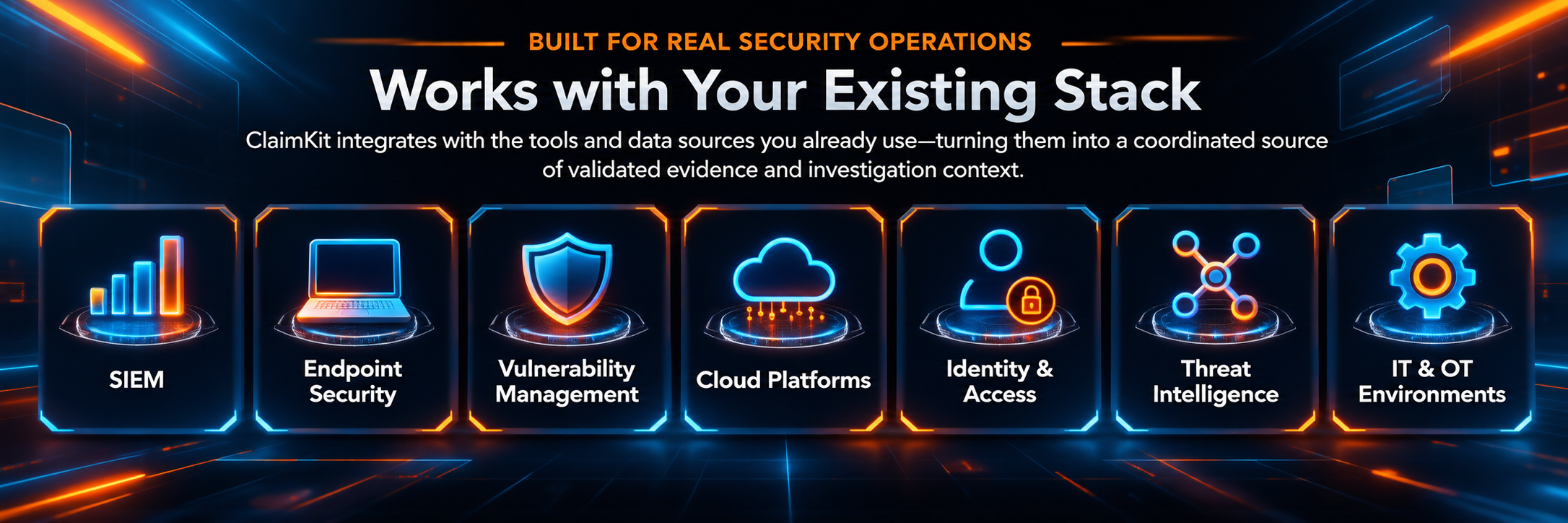
Bring Existing Security Data into the Investigation
Organizations already generate valuable security intelligence through SIEM, endpoint security, vulnerability management, identity and access systems, cloud platforms, threat intelligence, and IT/OT environments.
Within the HAWK security operations platform, ClaimKit transforms relevant source information into structured evidence for investigation. It evaluates relevance, preserves source provenance, and prepares focused evidence for downstream reasoning and verification.
This allows security teams and Octopus cAI to work from more relevant, traceable evidence while extending the value of the security technologies organizations already own.
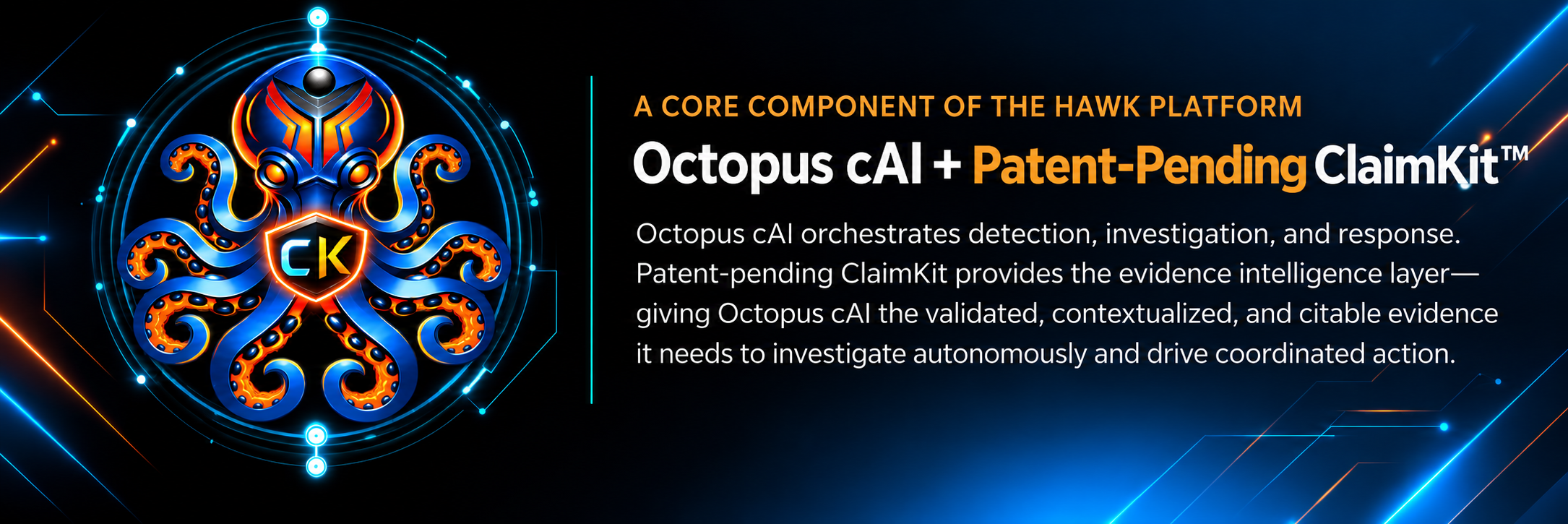
HAWK.io ClaimKit Provides the Evidence.
Octopus cAI Investigates.
ClaimKit and Octopus cAI work together within HAWK's security operations architecture, connecting structured evidence intelligence with autonomous investigation and coordinated response.
ClaimKit prepares the evidence.
It extracts verifiable claims, preserves source traceability, detects contradictions, evaluates answerability, and prepares structured evidence for AI reasoning and verification.
Octopus cAI conducts the investigation.
It uses relevant security intelligence and ClaimKit's evidence to investigate suspicious activity, validate findings, and support policy-governed response.
Together, these capabilities help reduce the time between security detection and authorized action.
Relevant Evidence → Autonomous Investigation → Validated Findings → Authorized Action
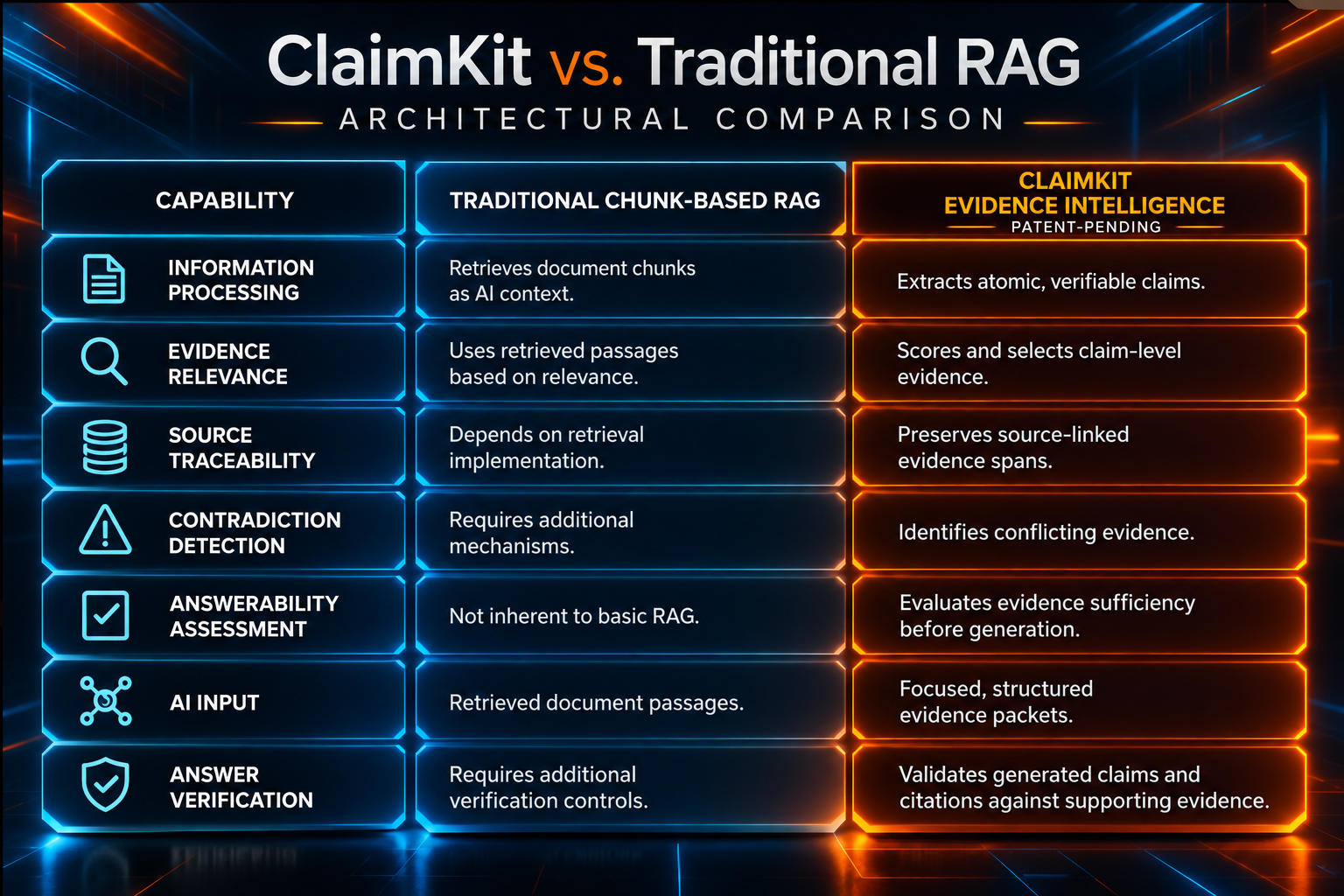
HAWK.io ClaimKit vs. Traditional RAG: Beyond Retrieval
Traditional Retrieval-Augmented Generation (RAG) commonly retrieves document chunks and adds them to an AI model's context.
Retrieval can improve access to relevant information, but retrieving information alone does not establish whether an answer is sufficiently supported, whether sources contradict one another, or whether generated statements accurately reflect the underlying evidence.
ClaimKit adds a structured evidence and verification process.
It extracts verifiable claims, maintains source-level traceability, assesses contradictions and answerability, and validates generated claims against their supporting evidence.
This creates a more controlled path from source information to evidence-backed answers.
Evidence Efficiency Is More Than Token Reduction
ClaimKit goes beyond traditional chunk-based RAG by transforming retrieved information into validated, contextualized, and citable evidence. Its architecture combines claim-level retrieval, source traceability, contradiction detection, answerability assessment, and answer verification to support more defensible AI-generated answers.
How ClaimKit Differs from Traditional RAG
Traditional chunk-based RAG retrieves passages for AI context. ClaimKit focuses on extracting verifiable claims, preserving source traceability, and checking answers against supporting evidence.
Beyond Retrieval: Evidence Control for Cyber AI
Traditional Retrieval-Augmented Generation (RAG) and Agentic RAG help AI systems access external information. But retrieving more information does not necessarily produce more reliable security conclusions.
Traditional RAG typically retrieves documents or passages and supplies them as context for an AI model. Agentic RAG extends that process through iterative searches, tool use, and additional retrieval steps.
Both approaches can improve access to information. Neither, by itself, guarantees that the evidence is authorized, current, relevant, non-contradictory, or sufficient to support a conclusion.
ClaimKit addresses a different problem: controlling what the AI is permitted to treat as factual evidence.
Its patent-pending architecture introduces claim-level retrieval, source-linked provenance, authorization controls, bounded evidence packets, and verification of generated assertions.
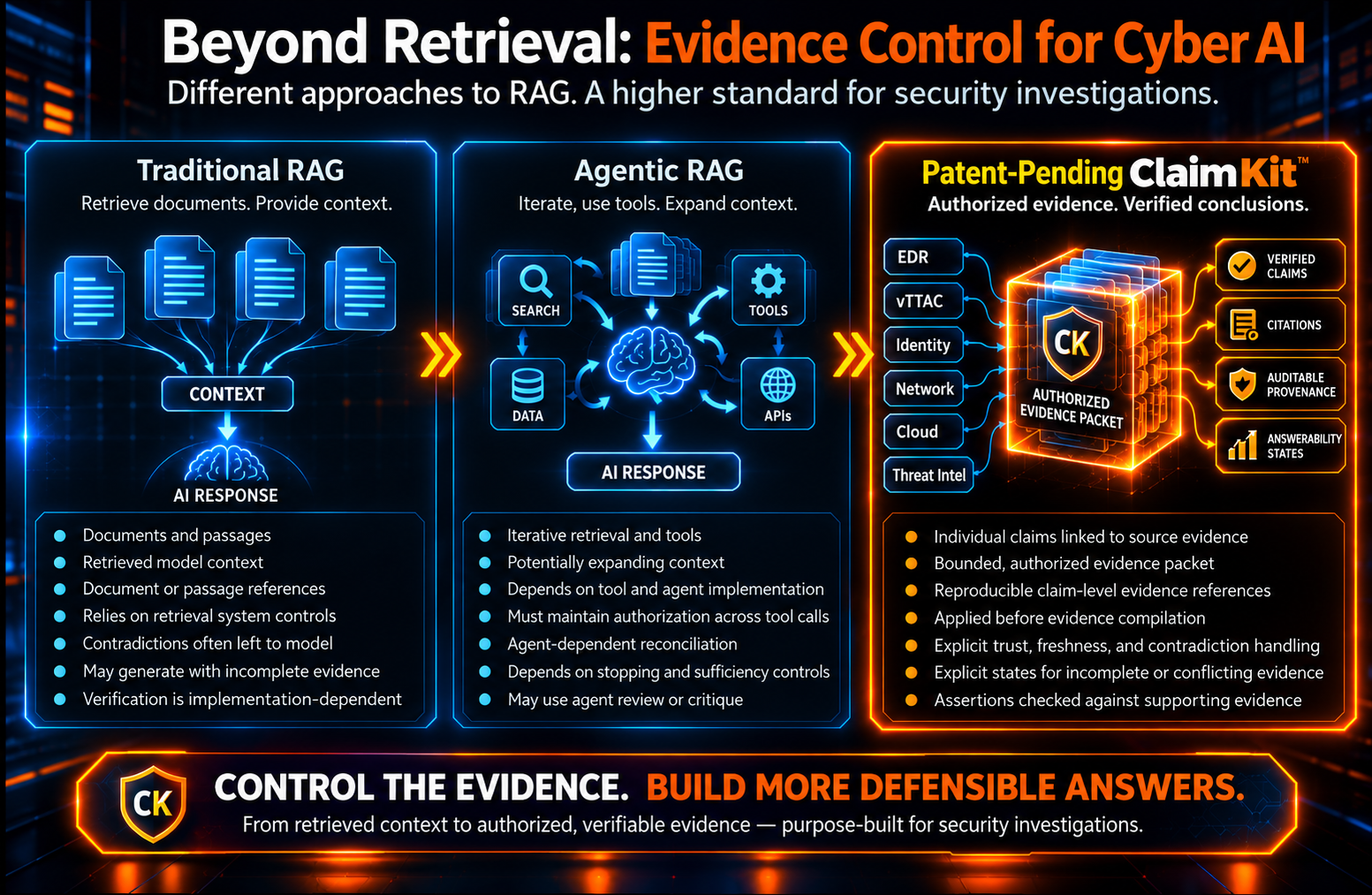
How the Approaches Differ
1. Retrieval
Traditional RAG: Documents and passages.
Agentic RAG: Iterative retrieval and tools.
ClaimKit: Individual claims linked to source evidence.
2. Evidence Boundary
Traditional RAG: Retrieved model context.
Agentic RAG: Potentially expanding context.
ClaimKit: Bounded, authorized evidence packet.
3. Provenance
Traditional RAG: Document or passage references.
Agentic RAG: Depends on tool and agent implementation.
ClaimKit: Reproducible claim-level evidence references.
4. Authorization
Traditional RAG: Typically controlled by retrieval systems.
Agentic RAG: Must be maintained across tool calls.
ClaimKit: Applied before evidence compilation
5. Contradictions
Traditional RAG: Often left to model reasoning.
Agentic RAG: Agent-dependent reconciliation.
ClaimKit: Explicit trust, freshness, and contradiction handling.
6. Answerability
Traditional RAG: Model may generate with incomplete evidence.
Agentic RAG: Depends on stopping and sufficiency controls.
ClaimKit: Explicit states for incomplete or conflicting evidence.
7. Verification
Traditional RAG: Implementation-dependent.
Agentic RAG: May use agent review or critique.
ClaimKit: Assertions checked against supporting evidence.
The distinction is not how much information an AI can retrieve. It is whether the AI can demonstrate that its conclusions are supported by authorized, verifiable evidence.
For security operations, this matters when AI is used to investigate incidents, evaluate suspicious activity, and support response decisions.
ClaimKit provides the evidence-control foundation for HAWK Octopus cAI, helping connect AI-driven investigation with traceable factual support.
Source: HAWK internal ClaimKit benchmark. Results apply to the evaluated test conditions.
ClaimKit: Frequently Asked Questions
What is evidence selection before AI investigation?
Evidence selection is the process of identifying and preparing the information most relevant to an investigation before that information is used for AI reasoning. In security operations, this helps reduce irrelevant context while preserving the supporting evidence needed to evaluate findings.
How does ClaimKit support autonomous security investigations?
ClaimKit identifies, extracts, and cites relevant evidence. Octopus cAI uses this focused evidence as part of its autonomous investigation and validation processes. This separation helps connect investigative conclusions to supporting information and enables more defensible security decisions.
Give AI the Evidence It Needs—Not Everything You Have
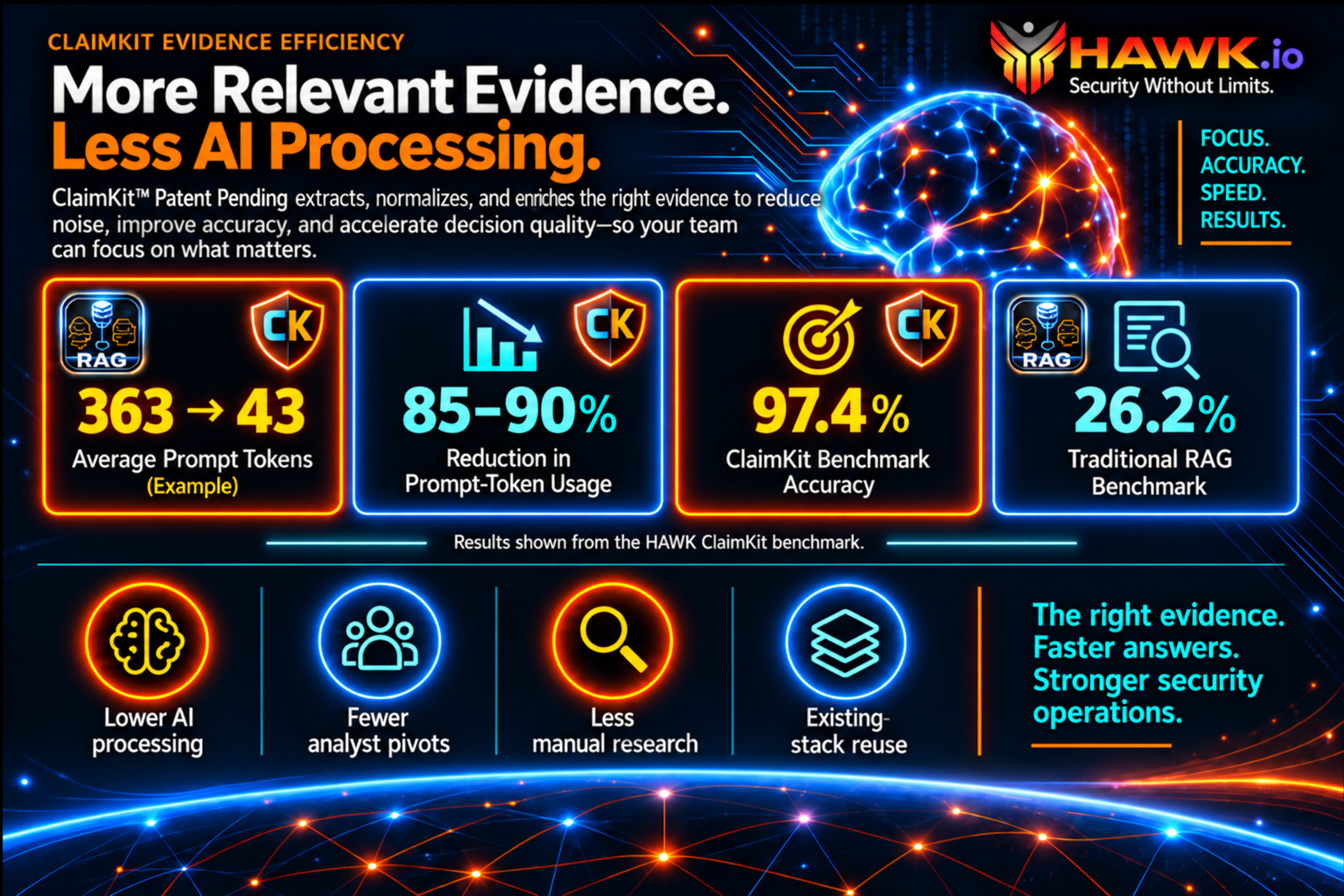
More security data does not automatically produce better security decisions. Traditional Retrieval-Augmented Generation (RAG) can retrieve a larger body of potentially relevant context for an AI model to process. In security investigations, that can also introduce unnecessary information and increase processing requirements.
ClaimKit takes a more evidence-focused approach. It identifies, normalizes, and delivers the evidence relevant to an investigation so Octopus cAI can reason from a more focused, evidence-grounded information set rather than processing everything that might be related.
HAWK.io ClaimKit vs. Traditional RAG:
97.4% vs. 26.2% Benchmark Accuracy
In HAWK's reported ClaimKit benchmark, ClaimKit Evidence Intelligence achieved 97.4% accuracy compared with 26.2% for traditional retrieval-augmented generation (RAG). The benchmark also reported a reduction in average prompt tokens from 363 to 43, illustrating how focused evidence extraction can reduce AI processing requirements while supporting more accurate, evidence-grounded security investigations.
The objective is not simply to use fewer tokens.
It is to reduce irrelevant context and unnecessary AI processing while preserving the evidence required to reach a well-supported conclusion.
How does HAWK.io ClaimKit help reduce AI token costs?
By reducing the amount of context sent to an AI model, HAWK.io ClaimKit can lower token-based processing costs per investigation while preserving the evidence needed for supported answers. Actual savings depend on model pricing and the investigation workflow.
Make Evidence Efficiency an Operational Advantage
A more focused evidence set can reduce AI processing, unnecessary analyst pivots, and manual research while helping investigations progress more efficiently from evidence → reasoning → validated findings → action.
For HAWK, that means ClaimKit is not simply another retrieval layer. It is evidence intelligence designed for security operations, giving Octopus cAI a focused, traceable evidence set for autonomous investigation and decision support.
The right evidence. Less noise. Less processing. Faster answers. Stronger security operations.
Results shown from the HAWK ClaimKit benchmark. Benchmark results reflect HAWK testing and should not be interpreted as universal performance across all RAG implementations or workloads.
See ClaimKit in Action
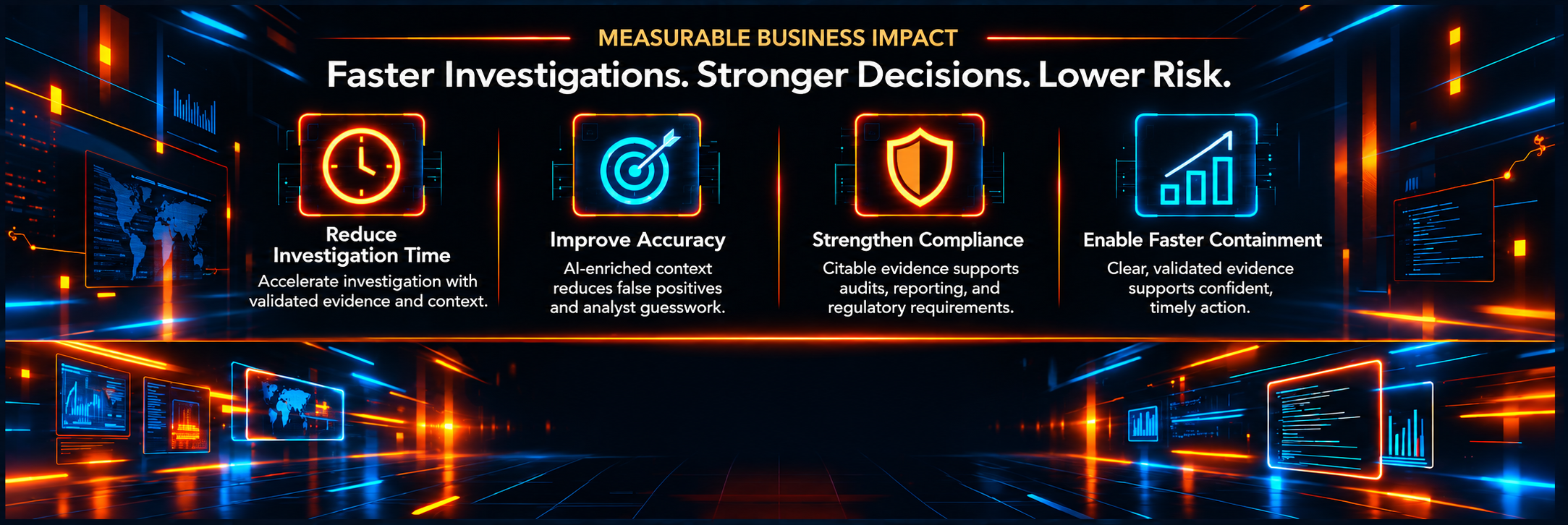
See how ClaimKit prepares evidence for an investigation and how Octopus cAI uses it to develop supported findings.