


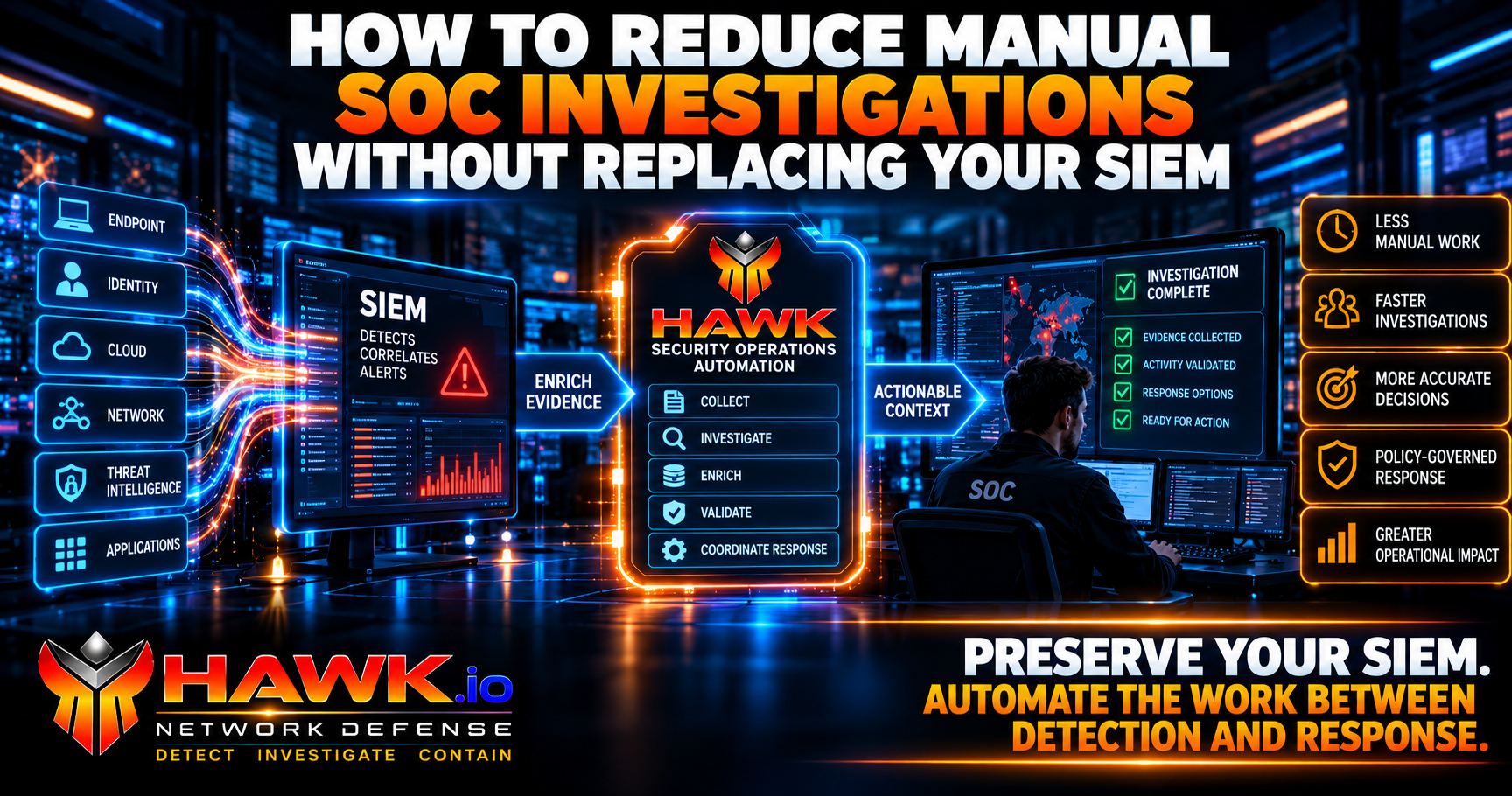
How to Reduce Manual SOC Investigations Without Replacing Your SIEM
Your SIEM detects suspicious activity, but analysts still spend hours gathering context, correlating evidence, and determining what to do next. Learn how evidence intelligence and autonomous investigation can reduce manual SOC work without replacing the security technologies you already own.
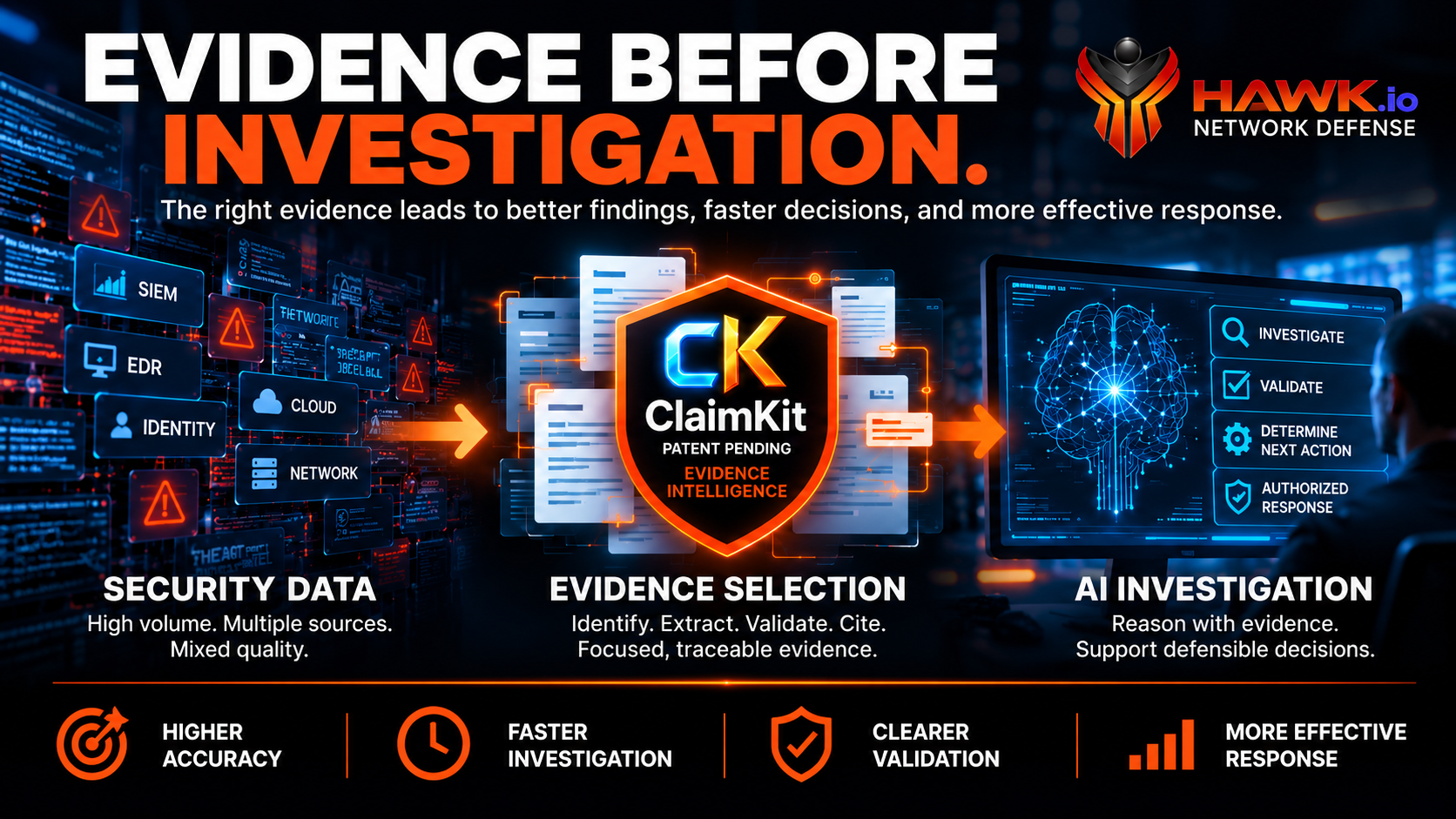
Why Evidence Selection Must Come Before AI Investigation
AI security investigations are only as reliable as the evidence behind them. Discover why selecting, validating, and citing relevant evidence before autonomous investigation matters—and how HAWK’s patent-pending ClaimKit supports evidence-grounded security decisions.

AI-Driven MDR: From Threat Detection to Validated Containment
AI-driven MDR should do more than detect threats. Discover how validated evidence, autonomous investigation, and authorized containment help security teams move from alerts to measurable outcomes.

The Board Will Eventually Ask: What Did AI Actually Change?
AI adoption is not the same as business value. David Harris examines what boards should expect from AI investments, including measurable ROI, operating efficiency, decision quality, risk reduction, and executive accountability. The real question isn't how much AI an organization deploys. It's what actually changes because of it.

Attackers Are Moving at Machine Speed. Is Your Security Operation Still Waiting on People?
Cyber threats can move faster than traditional security approval processes. David Harris examines why decision latency, manual handoffs, and unclear response authority can leave organizations exposed—and how AI-driven MDR, governed automation, and executive accountability can improve security outcomes.

The Business Doesn't Experience Your Security Tools Individually. It Experiences the Delay Between Them.
Strong cybersecurity tools do not automatically produce strong security outcomes. David Harris explains why the delays between detection, investigation, authorization, and containment create business exposure—and why executive leadership must focus on decision capacity, coordinated response, and measurable risk reduction.

Your AI Agent Should Have to Earn More Authority
AI agents should not receive unrestricted authority simply because they can perform an action. Tim Shelton explores progressive autonomy, evidence-based authorization, runtime enforcement, continuous evaluation, and why agent permissions must be capable of expanding—or contracting—as operational conditions change.

Containment at Machine Speed
Fast threat detection means little when containment takes hours. Tim Shelton examines three levels of security automation, how to establish response authority, why containment must be verified, and how AI-driven security operations can reduce decision latency without sacrificing human control.

When the Security Stack Sees the Attach but Can’t Stop it
The October 8, 2026, advisory on China-linked intrusion activity demonstrates how attackers exploit gaps between security technologies. HAWK examines why detecting reconnaissance, compromised identities, and persistent access is not enough—and why coordinated investigations, authorized response, and verified containment matter.

Detection Coverage is not Detection Effectiveness
Connected security tools do not automatically deliver effective threat detection. HAWK Network Defense explains the difference between detection coverage and detection effectiveness, including telemetry quality, cross-system correlation, scenario-based testing, and the ability to produce timely, actionable security findings.

Can Your Security Stack Actually Execute the Decision?
Detecting a cyber threat is only the beginning. HAWK Network Defense examines the operational gap between security decisions and response execution, including evidence gathering, authorization, automated containment, and verification. Learn five questions security leaders can use to evaluate whether their existing security stack can act when it matters.

Your EDR Sees the Endpoint. The Attack Sees the Environment.
EDR is essential, but modern cyberattacks extend beyond individual endpoints. HAWK Network Defense examines why security teams need broader identity, network, cloud, and business context to investigate threats effectively—and how coordinated security operations and AI-driven MDR can extend existing EDR investments without requiring wholesale replacement.

AI Guardrails vs. Policy-in-Code: Why Both Matter
AI guardrails and policy-in-code solve different security problems. HAWK Network Defense explains why safe AI-generated responses do not establish authorization, how runtime controls govern agent actions, and what enterprise leaders should require to maintain accountability over autonomous operations.

The AI Insider May Not Be Human
The next insider threat may not be human. AI agents can use legitimate credentials and approved tools while taking actions outside their intended authority. HAWK Network Defense examines non-human identity security, least-privilege permissions, enforceable authorization, continuous governance, and why a valid identity does not guarantee a valid action.

Security Visibility vs. Decision Context: Why More Data Isn't Enough
More security data does not automatically lead to better security decisions. HAWK Network Defense examines the difference between visibility and decision context, including validated evidence, business criticality, decision latency, authorized response, and verified containment.

The Most Dangerous AI Permission Is the One Nobody Remembers Granting
AI agents rarely begin with unlimited authority. Their effective permissions expand as integrations, credentials, APIs, and delegated workflows change. Tim Shelton examines permission drift, cumulative capabilities, temporary access, continuous authorization reviews, and why runtime enforcement must reflect what an agent can actually do—not merely what was approved at deployment.

The Future SOC Is a Decision System
The future Security Operations Center cannot simply be a better monitoring center. David Harris examines why SOC modernization must focus on evidence, decision authority, coordinated response, verified containment, and measurable business outcomes—and what CEOs should expect from a decision-driven security operation.

Cybersecurity ROI Is Measured in Time, Not Tools
More cybersecurity tools do not automatically mean less risk. David Harris examines how CEOs can evaluate security investments through decision latency, containment performance, analyst efficiency, measurable exposure reduction, and financial return—shifting the conversation from technology deployed to business outcomes achieved.

Agentic AI Changes the Control Problem
Agentic AI changes enterprise security by giving AI systems the ability to act, not just respond. Tim Shelton examines the difference between capability and authority, why prompts cannot replace enforceable controls, and how runtime authorization, human oversight, and continuous authority management help govern autonomous operations.

The Future SOC Will Be Built Around Evidence, Not Alerts
The future Security Operations Center will not be defined by alert volume. Tim Shelton examines how evidence-driven investigations, AI-assisted correlation, contextual analysis, and policy-governed automation can help security teams make defensible decisions faster and verify that their responses worked.