


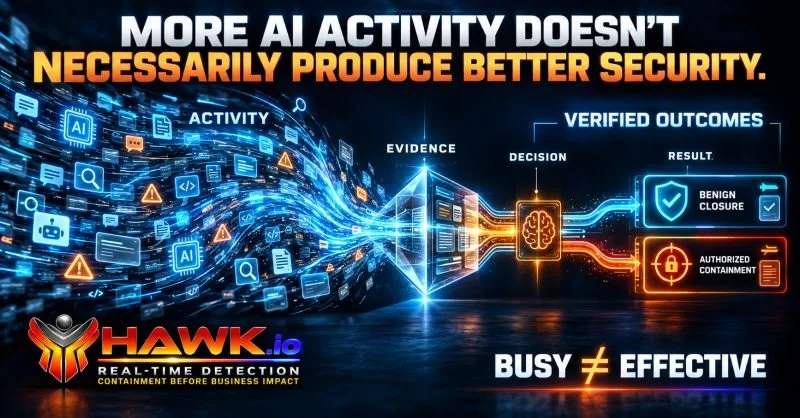
More AI Activity Doesn’t Necessarily Produce Better Security
More AI-generated alerts, investigations, and summaries do not automatically improve cybersecurity. HAWK Network Defense explains how validated findings, decision quality, analyst rework, response timeliness, and verified outcomes reveal whether AI is improving security operations.

What Happens Between Detection and Containment?
Detecting a threat is only the beginning. The time between detection, investigation, authorization, containment, and verification determines how long an organization remains exposed. Explore five questions security leaders should ask about the complete MDR response process.

What Should an AI Security Outcome Actually Cost?
The true cost of AI security goes beyond model tokens and API calls. HAWK Network Defense examines how analyst validation, investigation time, rework, decision quality, and business consequences determine the real cost of a security outcome.

Containment at Machine Speed
Fast threat detection means little when containment takes hours. Tim Shelton examines three levels of security automation, how to establish response authority, why containment must be verified, and how AI-driven security operations can reduce decision latency without sacrificing human control.

Detection Coverage is not Detection Effectiveness
Connected security tools do not automatically deliver effective threat detection. HAWK Network Defense explains the difference between detection coverage and detection effectiveness, including telemetry quality, cross-system correlation, scenario-based testing, and the ability to produce timely, actionable security findings.

Can Your Security Stack Actually Execute the Decision?
Detecting a cyber threat is only the beginning. HAWK Network Defense examines the operational gap between security decisions and response execution, including evidence gathering, authorization, automated containment, and verification. Learn five questions security leaders can use to evaluate whether their existing security stack can act when it matters.

Your EDR Sees the Endpoint. The Attack Sees the Environment.
EDR is essential, but modern cyberattacks extend beyond individual endpoints. HAWK Network Defense examines why security teams need broader identity, network, cloud, and business context to investigate threats effectively—and how coordinated security operations and AI-driven MDR can extend existing EDR investments without requiring wholesale replacement.

Security Visibility vs. Decision Context: Why More Data Isn't Enough
More security data does not automatically lead to better security decisions. HAWK Network Defense examines the difference between visibility and decision context, including validated evidence, business criticality, decision latency, authorized response, and verified containment.

The Future SOC Will Be Built Around Evidence, Not Alerts
The future Security Operations Center will not be defined by alert volume. Tim Shelton examines how evidence-driven investigations, AI-assisted correlation, contextual analysis, and policy-governed automation can help security teams make defensible decisions faster and verify that their responses worked.

More AI Will Not Fix a Poorly Designed SOC
Adding AI does not automatically fix fragmented security operations. Tim Shelton examines how disconnected tools, unreliable context, unclear response authority, and inefficient workflows can limit the value of SOC automation—and why organizations must redesign their decision processes before scaling AI.